

Off-grid living’s first requirement is a reliable source of clean water, no matter where you live. Once you have organized your source, its storage, and delivery, you can move on to preparing the lot and building your log home.
Off-grid log home systems primarily rely on a well or a rainwater collection system, a storage method like a cistern, and a means of moving the water, such as a pump or gravity feed. Other options include using nearby streams, springs, or lakes, while hauling in water is a manual alternative. A crucial component for all systems is a robust filtration and purification system to ensure water is safe for drinking.
Off-Grid Water Systems: Water Sources
Off-grid living requires a readily accessible year-round water system. Your choices depend on the home’s location, your budget, ease of use of the system, its maintenance, and your ability to operate the system. These are the typical sources of water used in today’s off-grid living:
- Wells: Drilled, dug, or bored wells provide a reliable, though often expensive, source.
- Rainwater: Collection systems use gutters and downspouts to fill a storage tank or cistern. A “first flush diverter” can be used to discard the initial, dirtiest water.
- Surface water: Nearby streams, rivers, springs, or lakes can be used, often requiring a pump to move the water uphill or to the home.
- Hauling: Manually bringing in water in large containers is available, especially for those who don’t require a constant large supply.
- Access to county water: Although technically not an off-grid source, some people hook up to the reliable county water system while using all other off-grid systems.
Off-Grid Water Systems: Storage And Delivery
Once you establish your source of water, the next step is determining how you will store and deliver it to your log home for use. Cisterns are large tanks or containers that store water from a variety of sources and are essential for surviving dry periods. They may be above or below the ground level. The best types of containers are typically polyethylene, stainless steel, or fiberglass due to their durability, safety for potable (clean and safe) water, and resistance to corrosion.
Pumps are needed to move water from a source that is lower than the storage tank or home. Pumps can be submersible (placed in the water source) or external, and need a power source, such as solar or a generator. If the storage tank is located higher than the point of use, gravity feed can be used for delivery, reducing the need for a pump.
‘‘Off-grid log home systems primarily rely on a good water source. A crucial component for all systems is a robust filtration and purification system to ensure water is safe for drinking.”
Off-Grid Water Systems: Essential Components
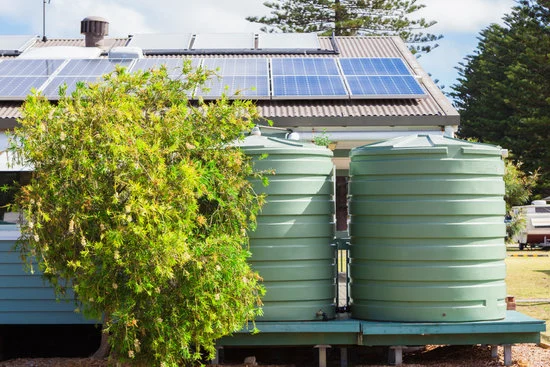 The essential components of a water system must be carefully planned and executed. In general, just reading about setting up an off-grid water system is not enough. You need to talk to those who are successfully using one and a professional whose business is water systems.
- Filtration and purification: A multi-stage system, including inline filters and a purification method like a UV sterilizer, is critical to making source water safe to drink.
- Plumbing: Use pipes, hoses, and valves made of certified drinking water-safe materials to avoid contamination.
- Freeze protection: Systems must be protected from freezing, especially in colder climates. This can involve burying pipes below the frost line or using heated enclosures for pumps and tanks.
- Power: Off-grid systems require a reliable power source for pumps and other equipment. Options include solar power, generators, or a combination of both.
- Protections from animals: If wild animals are potential problems in your area, ensure the storage tank, water lines, and pump are enclosed to protect them from animals chewing into them, causing leaks, and contaminating them.
Which Is The Best System And Its Cost?
The “best” off-grid water system depends on factors, such as water source, climate, location, and budget. A common and highly effective system is solar-powered pumping for drawing water from a well or cistern, combined with rainwater harvesting and multi-stage filtration for purification. For a no-electricity backup or simple needs, a gravity-fed filter can be a great addition.
The cost of your off-grid water system can vary from hundreds to thousands. The most expensive part of a system is drilling a well. Storage tanks, pipelines, pumps, and filtration systems all vary significantly, and you will need to carefully shop around to find a system to fit your budget and needs.
We hope these ideas provide a solid overview of off-grid log home water systems. Do sufficient research, and you will make the right decision for your needs. By the way, the most economical and fastest way to build an off-grid log home is constructing it with pine log siding, corners, and trims.






Recent Comments