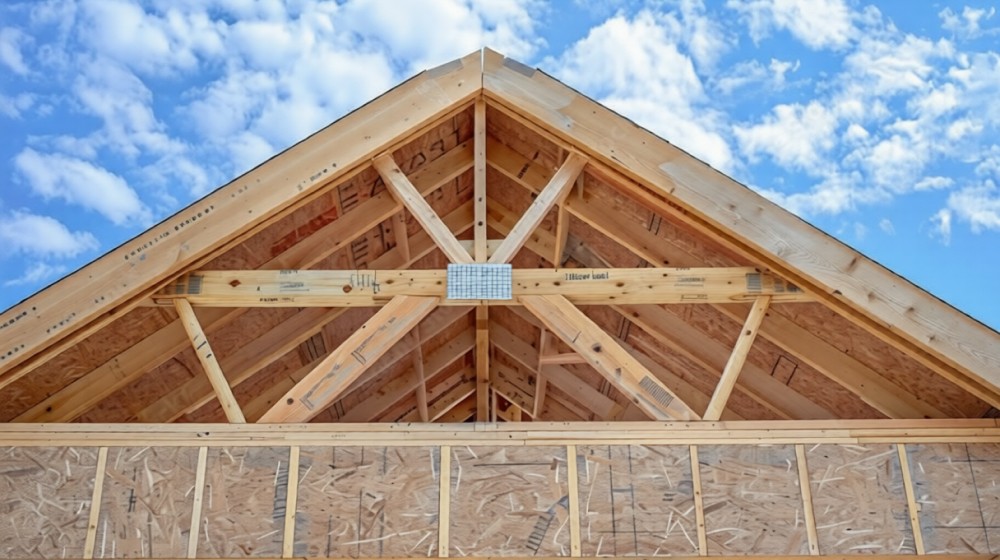
Log roof trusses offer significant advantages over traditional wood rafters, particularly in log homes and custom builds, by providing superior structural strength, faster installation, and greater design flexibility for open, vaulted spaces. Engineered to handle heavy loads, they reduce the need for interior load-bearing walls and arrive ready to install, saving labor costs and reducing onsite waste.
Advantages of Log Roof Trusses Begin With Strength
Superior Structural Strength: Log trusses are engineered to distribute weight efficiently, often resulting in higher load-bearing capacity compared to traditional stick-framed rafters. Log trusses offer superior structural support by utilizing triangular geometry to evenly distribute heavy roof loads like snow through compression and tension. By using massive timber members and engineered joints, they allow for open-concept spans without needing load-bearing interior walls, providing exceptional strength and structural integrity.
- Triangulation and Load Distribution: The core of a truss is the triangle, which is the most stable geometric shape. Triangulation ensures loads are transferred down to wall plates rather than causing sagging.
- Massive Timber Strength: Heavy log trusses are constructed from large solid or laminated wood members, which provide immense load-bearing capacity, often used in wide spans where traditional rafters would fail.
- Durability and Flexibility: The heavy, thick design helps the structure withstand extreme weather, such as heavy snow better than lighter, conventional framing.
- Engineered Connections: Modern log trusses often combine traditional heavy timber craftsmanship with advanced engineering, providing stability that accommodates natural shifts in temperature and humidity, reducing cracking over time.
Longer Spans For Open Spaces
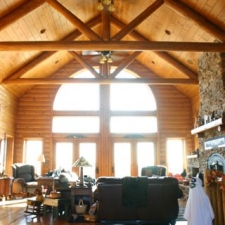
Log trusses can span vast distances without requiring interior support walls, making them ideal for large, open-concept “great rooms” and cathedral ceilings in log homes. Because they are exceptionally strong, they allow for expansive open interiors, as they can cover the entire space from wall-to-wall without needing intermediate support posts.
Log trusses have large beams at their bottoms that can be used for hanging lighting, artwork, decorations, trophies, and other personal items. They can be stained to match the walls, floors, or ceilings, or stained to contrast with them.
“Engineered to handle heavy loads, they reduce the need for interior load-bearing walls and arrive ready to install, saving labor costs and reducing onsite waste.”
Log Roof Trusses Are Faster And Easier To Install
 As pre-fabricated units, log trusses are delivered to the site ready to be lifted into place to provide faster and easier installation. This eliminates the time-consuming on-site measuring and cutting required for rafters, drastically reducing construction time.
The trusses are prefabricated off-site to precise engineering specifications to fit perfectly on the log wall structure. They simply need to be hoisted into place (usually by crane) and secured, significantly reducing labor hours and construction time. Consider these additional advantages:
- Pre-engineered and Pre-assembled: Trusses are efficiently designed and built in a controlled factory setting, ensuring uniform quality and consistent fit, eliminating the time-consuming on-site adjustments often required for traditional rafters.
- Reduced Labor: Because they arrive ready for installation, truss systems require less skilled labor and fewer crew members to install compared to “stick-framing” (rafters), which involves piece-by-piece assembly.
- Faster Framing Cycle: The “top-down” approach allowed by trusses means the roof structure can be set up in days rather than weeks, allowing interior work to begin sooner.
- Simplified Installation: They are designed with engineered, interlocking triangular shapes that are immediately strong, whereas conventional rafters require a ridge board, collar ties, and often temporary bracing during assembly.
- Simplified Layout: Trusses can span long distances without the need for load-bearing interior walls and posts, allowing for a faster, open-floor plan installation, whereas traditional rafters often require extensive temporary supports.
Log Roof Trusses Provide More
Because trusses are fabricated in a controlled factory setting, they minimize material waste compared to on-site rafter construction. In addition to their structural role, log trusses serve as dramatic architectural, rustic, or grand features that enhance the aesthetic appeal of cabins and high-end timber homes. Being engineered and produced in a factory ensures precise measurements and consistent structural quality for each unit.
How To Buy Log Trusses For Your Home
Buying log trusses for a home involves selecting a design, determining structural needs, taking measurements, and ordering from specialized manufacturers. Follow these steps for buying:
- Choose from popular styles, such as King Post, Queen Post, Scissor, or Arch.
- Measure your required span (width) and roof pitch.
- Determine how many trusses you need by measuring the spacing.
- Choose the log type of either hand-hewn (rough sawn) or smooth logs.
- Determine if they will be structural to hold up the roof or decorative only.
- Choose the supplier, fasteners, and finishing materials.
Log roof trusses provide many benefits compared to conventional wood rafters. You can purchase your trusses, log siding, and related log home building materials from The WoodWorkers Shoppe with complete confidence. Let us hear from you today.

Recent Comments